GLAM Bulletin
March 2020
This edition of the OpenGLAM Bulletin is dedicated to Linked Open Data. Why LOD? – Well, the most obvious reason is that Linked Open Data is a crucial element of the Internet today! It enables contents to be found by users, interconnects information from various sources and thus gives heritage institutions and their holdings greater visibility. The other reason is that lately, a lot has been going on in Switzerland with regard to LOD and GLAMs, which is why we want to keep you up to date with the latest projects!

What is LOD?

Some of you might not be familiar with the term Linked Open Data. If this is your case, you could start by watching this short video by Europeana, explaining what LOD is and why it is useful for heritage institutions: Linked Open Data - What is it?

Linked Open Data - What is it?
New Linked Open Data features in swissbib

swissbib, with more than 30 million records from 900+ libraries and archives gathers a lot of information about the collections of memory institutions in Switzerland. Most of its content is available as Linked Open Data under the portal https://data.swissbib.ch. This portal has been recently updated with a lot of new features and a new user interface. On top of that, the persons present in swissbib (for example authors) are now linked to wikidata and the number of links between swissbib and external data sources has been greatly increased. It is now possible to search within swissbib content based on wikidata properties (for example books by authors who received the Nobel Prize in Litterature) via https://data.swissbib.ch. More information is available on swissbib blog and further blog posts will be published in the next weeks.
 

Wikidata Hackday Series for Libraries

From June to November 2019, a Hackdays Series was carried out with staff members of three major libraries in Switzerland, namely the Swiss National Library, the ETH Library and the Zentralbibliothek Zürich, as well as OpenGLAM CH. The goal of this series, which was moderated by Beat Estermann from the Bern University of Applied Sciences, was to explore ways in which the libraries could engage with Wikidata – both by contributing data, and by using it to enhance their own service offerings. As the Hackday Series was rather successful, we want to draw your attention to the results!


The first project focused on enhancing the search experience for users browsing through library portals. During the Hackdays, the collection discovery system ExLibris Primo was expanded by drawing on Wikidata. This allows much more specific searches as it creates a bridge between the search term entered by the user – the string – to the actual thing, such as a specific person or place. You can try out the new functionality on a test system: enter a word and the system will suggest concrete persons or places to help you get more precise results.

The second project was dedicated to referencing archival fonds on Wikidata. By means of the property "archives at", the Wikidata item of a person can easily be interlinked with the Wikidata item of a heritage institution with relevant archival holdings on that person. Institutions can provide the inventory number and the reference URL to link it directly to the respective entry in the online catalogue. This makes the information retrievable for third party services, such as library discovery systems or archival platforms. The project team has published a step-by-step manual on “How to Link Your Institution’s Collections to Wikidata”.

The third project tackled the implementation of the “Sum of All GLAMs” project in Switzerland. The goal of this project is to add data about all heritage institutions on Wikidata and to make this data available on Wikipedia through infoboxes. Using Wikidata as a central location for information about heritage institutions eases the burden related to data maintenance, both for Wikipedia communities and data providers. Furthermore, the use of Wikidata driven infoboxes on Wikipedia will enhance the data's visibility and thus draw people's attention to possible errors and incomplete data.

Read more about the results of the Wikidata Hackdays Cycle here: https://outreach.wikimedia.org/wiki/GLAM/Newsletter/January_2020/Contents/Switzerland_report 

Linked Open Data Ecosystem for Heritage Institutions

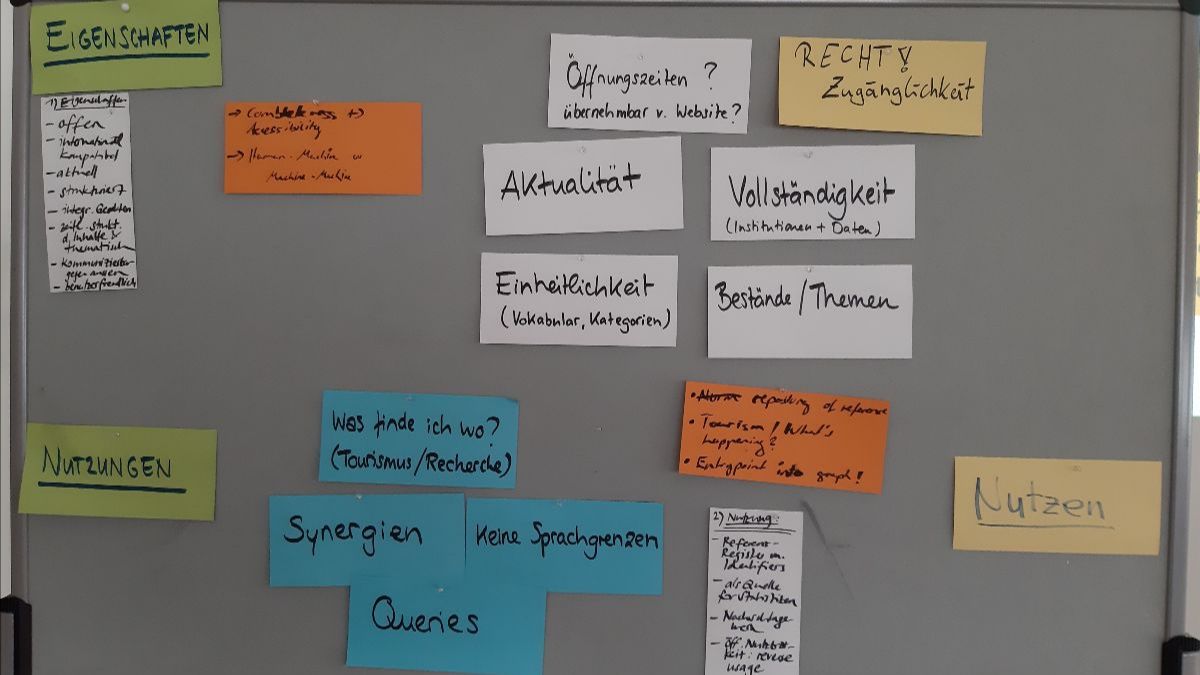
As a follow-up of the Wikidata Hackdays Cycles for Libraries, OpenGLAM CH organized a workshop on a “Linked Open Data Ecosystem for Heritage Institutions” (see the slides of the introductory presentation). We inspired ourselves from the data ecosystem approach in the field of the performing arts and discussed ways to transfer it to heritage data. The themes of the three workshops were: (1) Inventory of Swiss heritage institutions, (2) Interlinking of holdings (“archives at” in Wikidata) and (3) Linked data in the context of heritage data platforms: data provision and semantic search. The results of the workshop provide an overview of the current situation as well as action points to further pursue our collective endeavours towards the implementation of a LOD ecosystem for Swiss heritage institutions. The results of our workshop are documented here.

Brainstorming board of the workshop panel on the "Inventory of Swiss heritage institutions".
Towards Linked Open Data in Switzerland with the help of base registers and controlled vocabularies
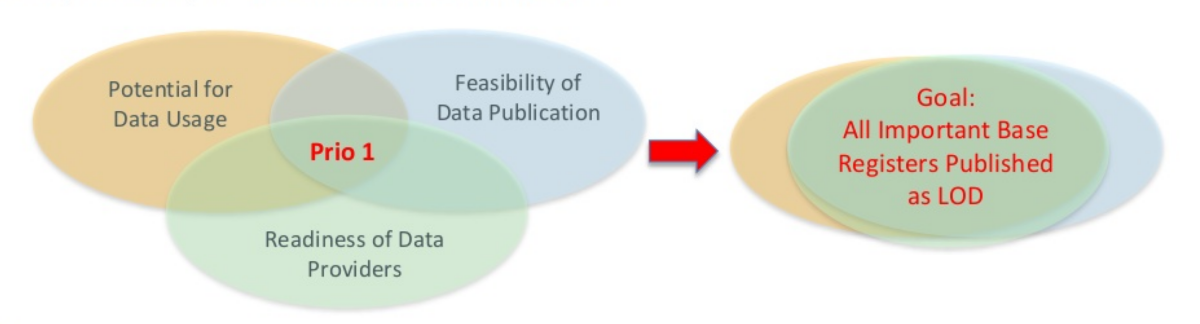
Criteria for the prioritisation of the publication of base registers as LOD. Taken from the study Basisregister und kontrollierte Vokabulare als Wegbereiter für Linked Open Data in der Schweiz.

Base registers and controlled vocabularies are central components of a linked data ecosystem: combined with commonly used data models or ontologies, they ensure that data can be interlinked beyond organizational boundaries. In order to promote the publication of linked data, E-Government Switzerland, at the request of the Swiss Federal Archives, commissioned an innovation project in 2019 with the aim of systematically tackling the LOD publication of base registers and controlled vocabularies by Swiss authorities. An “action research” approach was pursued in this project carried out by the Bern University of Applied Sciences in cooperation with Zazuko: on the one hand, two basic registers and a controlled vocabulary were published as Linked Open Data on a test server to shed more light on the practical challenges associated with data publication. On the other hand, prioritisation criteria for data publication were developed, and an online survey among the Swiss LOD community was used to rank data sets in terms of their potential use.

Although the area of heritage institutions was not the focus of the study, it was quite well covered due to the inclusion of administrative bodies such as the National Library and two state archives – and not least because of the participation of people with a GLAM background in the online survey. The results of the research are available here. 

News from Opendata.ch: Data Coffee & Prototype Fund

Our colleagues at Opendata.ch have been very busy since the beginning of the year! On the one hand, they have launched the awareness campaign “Data Coffee” to sensitize people about personal data. Opendata.ch offers you a cup of coffee in exchange for your data in order to make you reflect on the value of personal data in modern society. Due to the coronavirus, only the first edition in Zurich could be carried through, but we highly recommend the campaign website, giving you suggestions on how to understand, protect and benefit from your personal data: https://www.datacafe.ch/

On the other hand, Opendata.ch has launched a brand new prototype fund supporting projects that strengthen digital participation in the Swiss democracy. The fund is a collaboration with the Mercator Foundation and enables software developers, hackers, data journalists, creatives and political activists to realise their project with a grant of up to CHF 100.000. Check it out and submit your idea here: https://prototypefund.opendata.ch/

Further readings on LOD and cultural heritage
 

Upcoming events:


Friends of OpenGLAM

This newsletter is brought to you thanks to the kind support from the members of our Friends of OpenGLAM Network:
Twitter
Facebook
Website